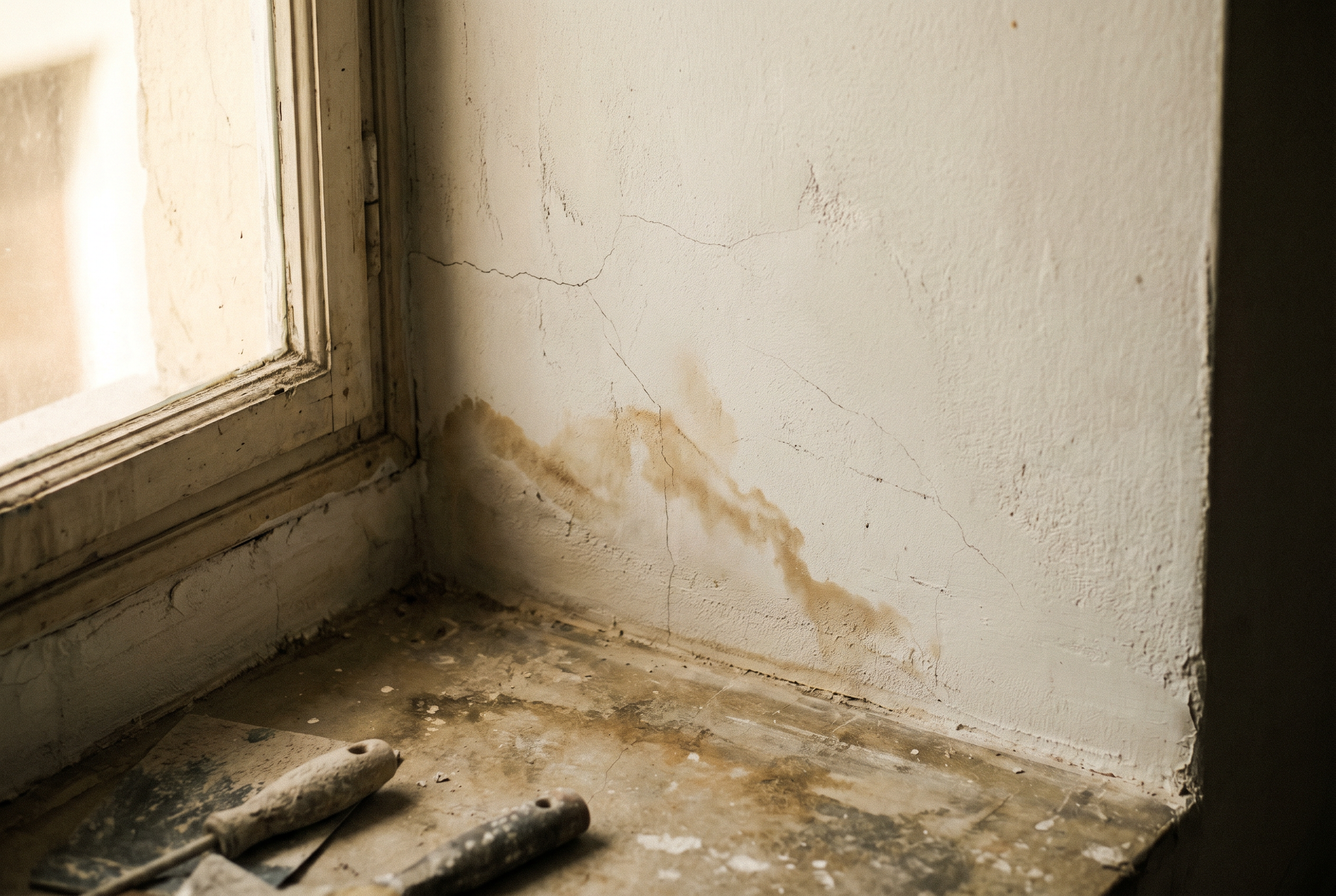
You walk into a viewing in Athens, or perhaps a village house in the Peloponnese. The walls are blindingly white. The smell of fresh paint hangs in the air. The agent smiles and says, "It has just been fully renovated."
For a foreign buyer, this is exactly what you want to hear. You don't want a project; you want a turnkey home. But in the Greek property market, the phrase "freshly painted" should not be a selling point. It should be a reason to look closer.
"Fresh plaster can hide an old problem." It is a phrase repeated in every expat forum and property guide. But what does it actually mean?
When a property is prepared for a quick sale, cosmetic fixes are often applied over structural or systemic issues. The goal is to make the property look perfect for the 20 minutes you spend walking through it. Here are the seven most common things that fresh plaster and a quick coat of paint are usually hiding.
1. Rising Damp (Ανοδική Υγρασία)
This is the most common issue in older Greek properties, particularly ground-floor apartments in Athens or traditional stone houses. Because older buildings lack modern damp-proof courses, moisture from the ground travels up the walls. A quick coat of waterproof paint or fresh plaster will mask the visual stains for about three to six months. By the time the first winter rains arrive, the paint will bubble, flake, and peel off.
2. Penetrating Damp from Poor Pointing
In traditional stone houses, the mortar between the stones degrades over decades. Instead of properly repointing the exterior—a slow, expensive job—sellers will often just plaster over the interior walls. The moisture still enters the wall, but now it is trapped behind the new plaster, slowly degrading the structural integrity of the stone.
3. Outdated, Unsafe Wiring
A "renovated" apartment often features brand new, shiny plastic sockets and switches. But what is behind them? It is incredibly common to find new faceplates attached to 40-year-old cloth-insulated wiring. The wall looks perfect, but the electrical system cannot handle the load of modern air conditioning units, creating a significant fire risk.
4. Structural Cracks (Ρωγμές)
Greece is a seismically active country. Minor settling cracks are normal and usually harmless. However, larger structural cracks—especially diagonal ones near windows and doors—indicate movement that needs professional assessment. A quick skim of filler and a coat of paint makes these cracks invisible to the untrained eye during a viewing.
5. Leaking Internal Pipes
If you see a freshly painted patch on a ceiling directly beneath a bathroom, or on a wall shared with a kitchen, be highly suspicious. Slow leaks from old plumbing are often "fixed" by painting over the water stain rather than breaking open the wall to replace the corroded pipe.
6. Poor Quality Insulation (or None at All)
Many older Greek properties have zero wall insulation. In summer, they are ovens; in winter, they are freezers. Sometimes, sellers will add a thin layer of plasterboard internally to make the walls look smooth and modern, claiming the property is "insulated." In reality, this creates a void where condensation forms, leading to severe hidden mould.
7. Illegal Extensions (Αυθαίρετα)
This is the most legally dangerous item on the list. A balcony that has been enclosed to create an extra room, or a basement converted into a living space, is often plastered and painted to seamlessly match the rest of the house. Visually, it looks like part of the original structure. Legally, if it has not been properly regularised (τακτοποίηση), you are buying an illegal structure and will be liable for massive fines.
Don't rely on the photos.
You cannot be there to check behind the fresh paint. We can. We visit the property, open the taps, check the walls, and give you an honest, independent report on what you are actually buying.
Book a Condition ReportHow to Protect Yourself
You do not need to be a structural engineer to spot these cover-ups, but you do need to know where to look, and you need to be physically present in the property. You need to run your hand along the bottom of the walls to feel for cold spots. You need to look at the exterior walls to see if they match the interior layout. You need to open the electrical panel.
If you are buying remotely, you are relying entirely on the agent's video tour. And a video tour will never show you the faint smell of damp in the back bedroom.